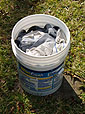
 Here's a backyard experiment I conducted three years ago. Step One. I drilled a 3/4" hole in the bottom of this five gallon plastic bucket and filled it with whites and grays from my sock and underwear drawer as you see here.
Here's a backyard experiment I conducted three years ago. Step One. I drilled a 3/4" hole in the bottom of this five gallon plastic bucket and filled it with whites and grays from my sock and underwear drawer as you see here.
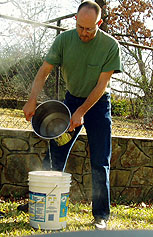 Step two. I heated five gallons of tapwater with a propane crab boiler and poured the boiling water over my socks and underwear. Note: This generated what I later referred to as the horrible horrible smell, just the same as when I poured boiling water over carpeting that I removed from the house.
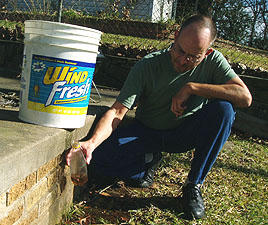 Step three. As the water percolated through the fabric I collected samples in clear plastic bottles. I collected the samples from the last half of the filtrate in order to allow the heat in the system to equilibrate thus assuring that the sample was gathered at the same temperature each time.
Steps two and three were repeated thirteen damn times, and the filtrate samples were retained in order.
Step four. Line up all those samples in order and see what came out in the wash. Here they are, first sample on the left and last sample on the right. What do you think?
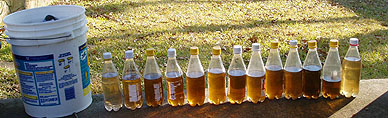 Excuse the dumb joke, but this knocked my socks off. Notice first the tea-stained discoloration of the water and second notice that after being rinsed with 65 gallons of boiling water the discoloration is still there. I think anybody would be alarmed by this. In my supposedly clean clothes I had a stain and a smell that made me ill. Not only that, but thirteen rinses with boiling water reduced neither the smell of the steam nor the stain in the eluant. Take a look at that line of bottles and confirm that the situation wasn't improving with repitition. Legitimate cause for concern I think.
These were supposed to be clean already, detergent washed in hot water. I got these out of the drawer, not out of the hamper. They looked clean to me and smelled like laundry. Obviously, detergent and hot water either don't remove this brown, stinky stainy oily plasticky smelling stuff or they contribute to my clothes being filled with this brown, stinky stainy oily plasticky smelling stuff.
If you've been following my rants on the horrible horrible smell, this is where that preoccupation came from. After discovering this nastiness I had to know what this brown stain was, what was the smell, where did it come from and how do I get rid of it. Obviously if this stuff was in my carpet and in my clean socks and underpants, it must also be in my bedding and upholstery and probably in my cabinets and drywall and linoleum and everywhere else. No amount of boiling water was going to solve my problem.
I eventually found something a little easier than boiling water to remove this brown stinky stainy stuff. Replace your scented laundry detergent with household ammonia. Also, don't use fabric softener. Something in it apparently contributes to this stain and smell over time. As a rule of thumb, anything with a powerful artificial scent should be avoided. Check my previous rants for tips on how to remove the horrible horrible smell from various materials.
You can spot check your own sock drawer with a shorter version of this experiment. Just boil some socks and underwear for fifteen minutes in a stock pot full of tapwater. Pour the water into a glass and see if it's stained.
RTJ -- 8/3/2010
CEDAR
If you take on the project of removing this smelly stainy stuff from your clothing, don't neglect the drawers and cabinets, particularly if they are cedar. Cedar more than any other wood absorbs this stainsmell like a sponge, which is great when the cedar is new because it takes the stainsmell out of your clothes. This might be one reason chests and drawers and wardrobes were customarily made from cedar. However, over the years the cedar becomes saturated and then it's a reservoir that puts the guck back INTO your clothes.
To see if your cedar is contaminated, take the drawer out of the cabinet, flip it over to expose an unfinished surface and spray it down with household ammonia. Wipe with a clean white rag. If the rag comes up brown as caramel then your cedar is loaded up and needs to be replaced or cleaned. You can soak the drawer for an hour in a tub of water spiked with a cup of household ammonia. If you're afraid of warping the wood, or if you can't get the piece into a tub, you can spray and wipe until the stain no longer comes out. Wear gloves. That stuff can get into your skin same way it got into that wood.
RTJ -- 8/9/2010
Check your kitchen. Do you have a cedar chopping board or a big block of cedar where you store your cutlery? How about a wooden skimmmer or wooden spoons. Put those in the soak with a couple of ounces of ammonia. As you watch the water turn brown think to yourself that every time you had your food on that cutting board and cut it with that cutlery you were putting that stain into your food. No more. Send it down the pipe to the sewage plant.
.....
Ohmygodohmygodohmygod!
It's been about ten hours since I started to soak my cutlery block, and it's clear that I've discovered the number one source of stinkystain in my house. I've changed the soak five times and still the ammonia pulls out more green-brown-gray taint. There is nothing in my house to compare with how nasty this thing was. And I had my kitchen knives touching right against this wood. Unbelievable.
Now what to do. This stuff is so nasty I'd be reluctant to reclaim it as a cutlery block. On the other hand, this demonstrates the capacity of cedar to absorb this stuff right out of the air, so can I really afford not to have a big block of cedar on my countertop?
I'm going to soak this thing until it's clean, however long it takes. Then I'll put it back to work.
RTJ -- 8/16/2010
It's thirtysome hours after I started the cutlery block soak experiment and ammonia still draws color from the wood.
I ended the sock drawer experiment when I ran out of propane, not because I had managed to leech all the color out of the material. Similarly I'm getting tired of changing the soak water for the wood block, which by the way has now disintegrated because the glue got softened.
Out of boredom I changed the solvent from ammonia to grain alcohol and the water turned a bilious green, the very color of illness itself. Obviously this wood is infused with a lot of pigments of various kinds. I don't know if it's harmful or not, but why should it be there at all? Did it accumulate over the years or was it there when I bought it?
RTJ -- 8/17/2010